
I have basically understood how MOSFETs work and the meaning of their symbols for a while now, but I was going through a textbook on microelectronics I wrote up this reminder for myself. Here goes.
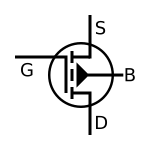
The arrow on a MOSFET transistor symbol tells you which kind of MOSFET you're looking at, p-channel or n-channel. However, the manner in which the arrow indicates that varies depending on the symbol in question. First, let's look at the symbol below where the body is given an explicit pin:
In this symbol, the arrow represents the direction of the p-n junction in the body between the inversion layer and the rest of the body.
So, if the arrow points toward the gate, the body is p and the inversion layer is n, so the MOSFET is an n-channel MOSFET.
If the arrow points away from the gate, the inversion layer is p and the body is n, making the MOSFET a p-channel MOSFET.
When the body is tied to one of the terminals, the symbol can take multiple forms. The first form of the symbol looks like a lot like the one before. The body p-n junction is indicated explicitly, and the arrow representing the body junction is connected to one of the terminals via a line:

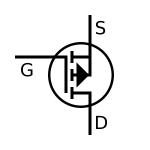
Notice I didn't say that the body is connected to the source via a line. That's because it's not that there is already a "source" terminal and "drain" terminal and we choose to short the body to the source. It's that when the body of a MOSFET is tied to one of the terminals, that terminal necessarily becomes the source terminal. That's true whether you are talking about n-channel or p-channel MOSFETs.
This is because the same gate voltage which attracts minority carriers in the body to form the inversion layer also attracts majority carriers in the terminal due to their complementary doping. The latter attraction determines the direction of the flow of charge carriers in the inversion layer and makes the connected terminal the source of the charge carriers. [1]
This view is very nice and it will give us insight into the final symbol form below:
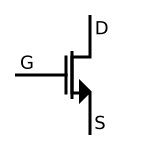
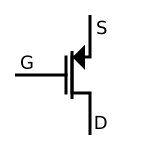
In this form of the MOSFET symbol, the arrow representing the body is merged with the line representing the source. And the direction of the arrow has a different meaning. In this symbol, the arrow points in the direction you have to bias the terminals it sits between to turn on the MOSFET. And it sits, as we now know, between the gate and the source-plus-body.
So, if the arrow points towards the gate, the electric field of the bias points toward the gate, and positive charges are attracted to the gate, meaning the MOSFET is p-channel.
And, if the arrow points away from the gate, the electric field of the bias points away from the gate, and negative charges are attracted to the gate, meaning the MOSFET is n-channel.
Finally, if the bias is applied in the direction of the arrow, then in addition to the electric field produced in the body in the direction of the arrow, there is an electric field produced in the source in the direction of the arrow, since they're shorted. This lets us come to the helpful corollary that in this symbol, the arrow points in the direction of conventional current when the MOSFET is on.
With this symbol form, it's easy to know how to bias the MOSFET, but harder to know whether it's n-channel or p-channel. With the other form, it's easier to know whether it's p-channel or n-channel, but harder to know which way to bias it to turn it on.
If you want to think about it the other form physically, it gets complicated. It's easy to tell where you need to apply the bias by looking at which terminal the body is shorted to. But which direction do you apply the bias? My thought process goes, okay, the arrow is pointing at the n portion of the inversion layer-body boundary. How do I form the inversion layer? Produce a field in the opposite direction of the arrow. Okay, now I know which way to bias it.
A non-physical shorthand which I will try to use henceforth is that in the more physically descriptive symbol, the arrow is something that has to be overcome, so you apply a bias opposite the arrow.
[1] You might ask, what if there is a bias applied between drain and source which opposes this E-field? In that case, you have the body-drain junction forward biased and charge flows through that just like a regular diode and the whole inversion layer operating principle has gone out the window.
Please send comments to blogger-jack@pearson.onl.